Get storm-ready! Be hurricane-prepared BEFORE the season starts.
Our Services
Emergency Tree and Crane Services
Emergency tree work often involves significantly more risk than routine trimming or removal. Heavy limbs may be resting against roofs, trunks can remain under tremendous tension, and partially uprooted trees may shift without warning. Our crews evaluate the tree, surrounding structures, access conditions, and load before determining how to remove the hazard while limiting additional damage.
For urgent situations involving large trees or difficult access, Tangi Tree’s crane equipment allows sections of the tree to be supported, lifted, and moved away from structures instead of simply being cut and allowed to fall.
When Emergency Crane Services Are Needed
A crane is not necessary for every damaged tree, but certain emergencies are much safer and more manageable when the tree can be lifted rather than dropped. Emergency crane services are particularly useful when trees are leaning over buildings, tangled with other trees, resting against structures, or positioned where there is little room for conventional removal.
Crane-assisted removal may be appropriate when:
-
A tree has fallen onto a house, garage, or commercial building
-
A large limb is suspended over an occupied structure
-
A storm-damaged tree is partially uprooted
-
A tree is blocking a road, driveway, or access point
-
The trunk has broken but remains hung up in nearby trees
-
Heavy sections cannot be safely lowered using standard rigging
-
A hazardous tree is located within a confined property
-
Storm debris makes traditional equipment access difficult
The goal is not simply to remove the tree quickly. The removal method must account for where the tree's weight is resting, how the remaining wood may move once cuts begin, and what buildings, utilities, vehicles, fences, pools, or landscaping are located underneath it.
Storm-Damaged and Fallen Tree Removal
-
Severe thunderstorms, tropical systems, hurricanes, saturated soil, and high winds can place tremendous stress on mature trees. Sometimes the damage is obvious immediately, such as a tree lying across a roof. Other problems develop more gradually after the weather has passed.
-
A tree with a compromised root system can remain standing temporarily before eventually falling. Broken limbs may stay lodged high in the canopy, while split trunks can continue separating under their own weight. That means a property may still contain serious tree hazards even after skies have cleared.
-
Our storm damage crane services are designed for these difficult situations. Depending on the size and position of the tree, our crews can use crane equipment to stabilize damaged sections before separating and removing them piece by piece.
-
For widespread storm events, we can also respond to properties where multiple trees or large amounts of woody debris need to be addressed. Each site is evaluated individually so that the most immediate hazards can be identified before removal begins.

Trees on Homes, Roads, and Structures
Few tree emergencies are as stressful as discovering a tree resting on your home or another structure. Once that happens, cutting branches without understanding how the tree's weight is distributed can cause sections to shift, potentially creating additional structural damage.
Emergency crane tree removal provides greater control in these situations because the crane can support heavy portions of the tree before they are cut free. Instead of allowing those sections to drop onto the structure, crews can lift them vertically or move them toward a safer landing area.
Crane-assisted removal may be used for trees affecting:
-
Homes
-
Garages
-
Commercial buildings
-
Apartment properties
-
Driveways
-
Roads
-
Fences
-
Pools
-
Sheds and accessory structures
Trees blocking roads or driveways can also create secondary problems by preventing residents, contractors, or emergency personnel from reaching a property. Removing those obstructions quickly can restore necessary access while larger cleanup operations continue.
Emergency Grapple Saw Operations
Certain tree emergencies can be handled even more efficiently with a grapple saw. This specialized attachment allows sections of a tree to be held securely while they are cut, giving operators considerable control over how each piece is separated and removed.
Our emergency grapple saw services can be particularly valuable when a tree is positioned above a building, surrounded by obstacles, or otherwise difficult to reach safely with conventional climbing and rigging techniques.
The grapple holds the section before the saw makes the cut. Once separated, the piece remains controlled by the equipment and can be lifted away from the hazard area.
This method can reduce the amount of manual cutting required in unstable portions of a damaged tree while allowing large sections to be moved without dropping them onto the property below.
Our Emergency Response Process
Every emergency tree situation is different, which is why the response begins with an assessment rather than a one-size-fits-all removal plan.
Evaluate the Immediate Hazard
Our crew first examines the position of the tree, damaged limbs, nearby structures, access conditions, and other hazards that could affect removal.
Determine the Appropriate Equipment
Depending on the situation, the job may require crane assistance, grapple saw equipment, rigging, loaders, ground crews, or a combination of several techniques.
Stabilize the Tree
When necessary, heavy sections are supported before cutting begins so that their movement can be controlled during removal.
Remove the Hazard in Sections
The tree is dismantled according to the safest available sequence. Sections may be lifted away from buildings or lowered into designated areas where ground crews can process them.
Clear the Immediate Work Area
Once the hazardous portions have been removed, debris can be moved away from important access points and structures as the cleanup progresses.
For major storms, conditions throughout the region may affect travel, access, and the order in which emergency calls can be addressed. Properties involving immediate hazards to structures or essential access often require particularly careful coordination.
Why Crane-Assisted Removal Is Safer
Traditional tree removal frequently relies on gravity. A limb is cut, lowered, or allowed to fall into a predetermined area. During an emergency, however, there may be no safe landing area available.
How Crane-Assisted Tree Removal Works: A crane changes the mechanics of the operation by supporting the weight before the section is fully detached. Once the cut is complete, that portion of the tree can be lifted away from the structure rather than dropping toward it.
Managing Heavy Wood & Storm Damage: This controlled approach can be especially important when dealing with extremely heavy wood. Mature trunks and major limbs can weigh thousands of pounds, and storm damage may make their behavior much less predictable.
Safer Access for High-Risk Trees: Crane equipment also allows crews to reach portions of damaged trees that would be dangerous or impractical for a climber to access. When the trunk is split, the root plate is unstable, or the canopy has been severely damaged, limiting the need for personnel to enter unstable sections of the tree can significantly improve job-site safety.
Customizing the Safest Tree Removal Strategy: The safest method still depends on the individual property. Our crews determine whether 24/7 crane tree removal, grapple saw equipment, conventional rigging, or another strategy provides the best way to control the hazard.
Areas We Serve
Tangi Tree provides emergency tree and crane response throughout Louisiana and the Gulf South. Our crews work with homeowners, businesses, property managers, municipalities, and other property owners dealing with fallen trees, storm damage, hazardous limbs, and difficult removals.
Our service capabilities are particularly valuable after hurricanes, tropical storms, severe thunderstorms, and other weather events that can create widespread tree damage across Southeast Louisiana and surrounding areas.
Because major storms can affect many communities simultaneously, response conditions can vary depending on road access, equipment requirements, and the severity of individual hazards.

Service Area
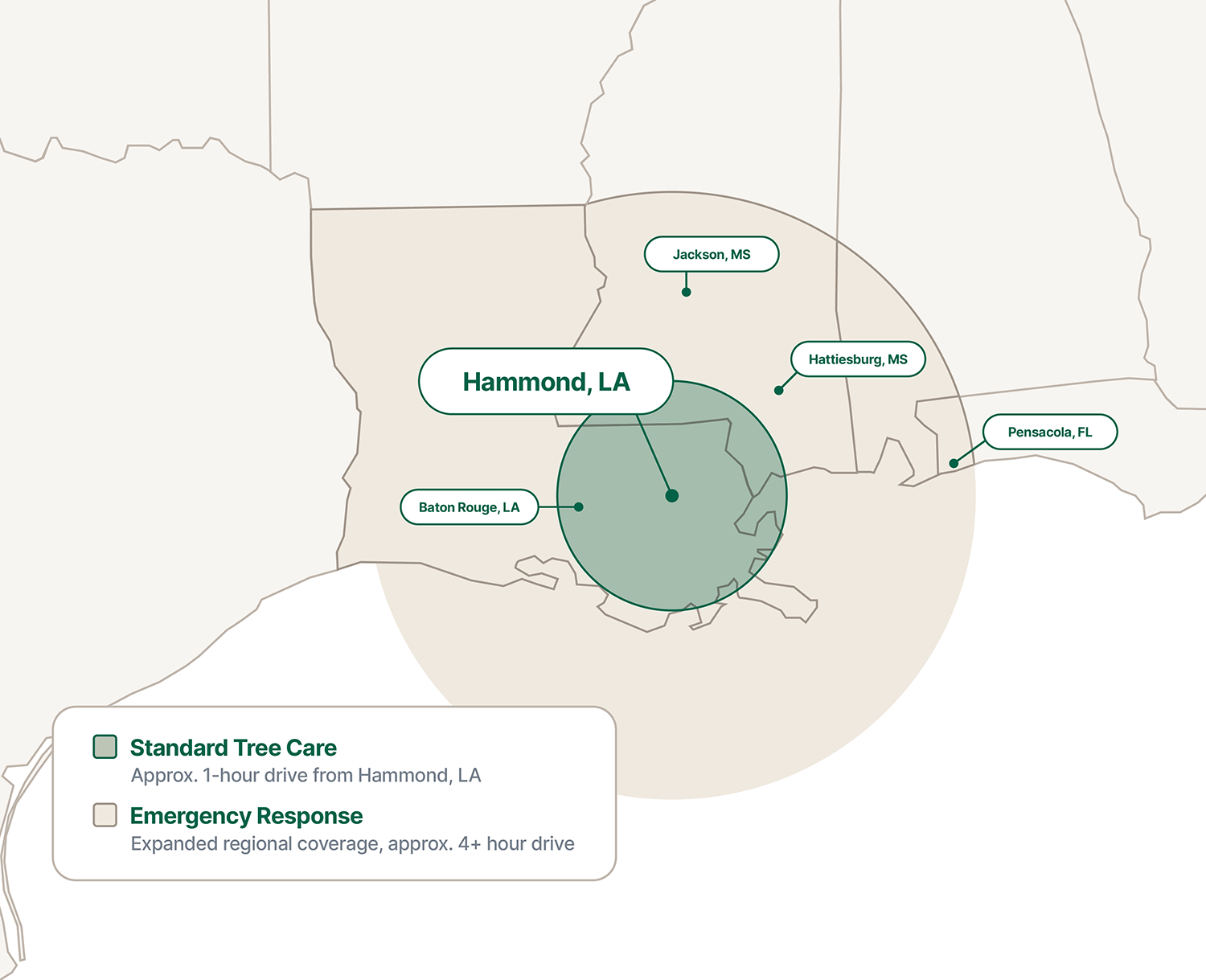
Tangi Tree is dedicated to providing clients across the Northshore/Florida Parishes area of Louisiana with a full spectrum of tree services. Our standard tree care service area includes locations within approximately one hour of Hammond, covering services such as Plant Health Care, scheduled removals, and pruning.
Our emergency response service area extends much farther, serving clients across a broader region within approximately four or more hours of Hammond.
Our service area includes, but is not limited to:
Tangipahoa Parish
St. Tammany Parish
Goodbee
Madisonville
Mandeville
Abita Springs
Covington
Folsom
Bush
Sun
Lacombe
Slidell
Pearl River
Livingston Parish
St. Helena Parish
Montpelier
Greensburg
Pine Grove
East Baton Rouge Parish
East Baton Rouge
Central
Zachary
Baker
Frequently Asked Questions
When Should I Call for Emergency Crane Services?
Call for emergency crane services when a large tree or limb creates an immediate hazard that cannot be safely handled through conventional tree removal. Situations involving trees on homes, unstable trunks, partially uprooted trees, suspended limbs, or extremely limited drop zones commonly require crane assistance.
If a damaged tree is near electrical lines, stay away from the area and contact the appropriate utility provider or emergency authority before approaching it.
Can You Remove Trees From Homes and Buildings?
Yes. Crane-assisted tree removal is especially useful when trees or large limbs are resting on homes and other structures. The crane can support sections of the tree before they are cut, allowing those pieces to be lifted away rather than dropped onto the building.
The exact removal strategy depends on the tree's position, structural conditions, equipment access, and how its weight is distributed.
Do You Provide Storm Response Services?
Yes. Tangi Tree provides emergency response for storm-damaged, fallen, and hazardous trees throughout Louisiana and the Gulf South. Services may include crane-assisted tree removal, grapple saw operations, removal of trees blocking roads or structures, and cleanup of major woody debris.
Storm response availability can depend on weather conditions, road access, regional demand, and the severity of the hazard.
Is Crane Removal Safer for Emergency Situations?
In many complex tree emergencies, crane-assisted removal can provide substantially greater control than relying on conventional cutting alone. Supporting heavy sections before they are separated allows crews to manage their movement and keep them away from buildings, vehicles, pools, fences, and other obstacles.
A crane is not automatically required for every emergency tree job. The safest approach is determined after evaluating the tree, property, access, and surrounding hazards.
 Fully Licensed Arborists
 Insured, Bonded and Licensed
 Experienced and Professional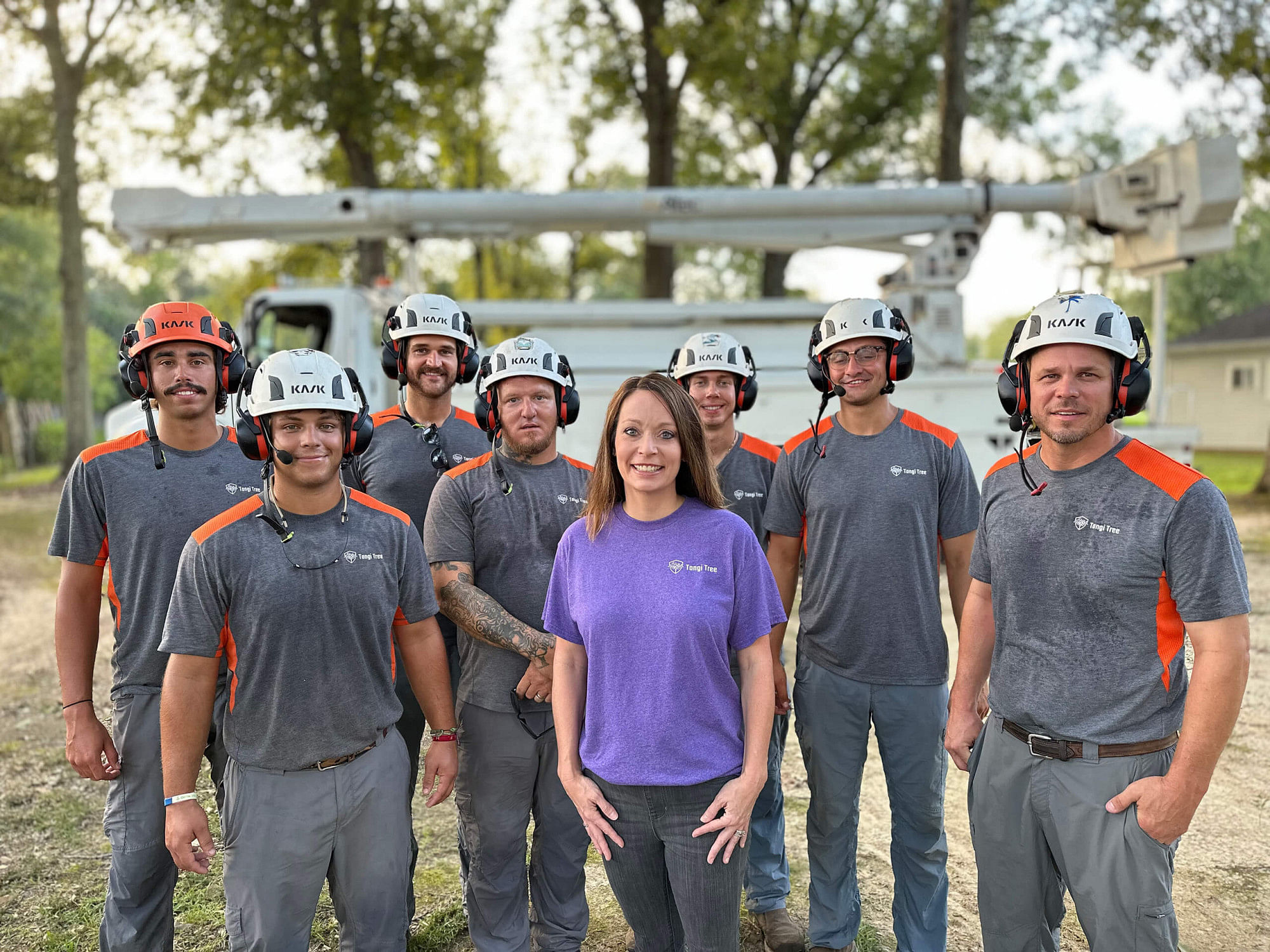
Request Emergency Tree Assistance Now
Tangi Tree provides emergency tree and crane service, including emergency crane services, emergency crane tree removal, storm damage crane services, and emergency grapple saw services for difficult tree hazards throughout Louisiana and the Gulf South. Contact Tangi Tree ASAP to request emergency assistance and have your property evaluated for the safest available removal approach.
5 Stars On Google
Testimonials


Tangi Tree is an ISA-certified arborist and DBE-certified contractor providing professional tree care across the South, backed by Louisiana state licensing and industry certifications.
Arborist License #2577 #2665
(985) 370-6100 




On Staff
Quick Links
Services
Get in Touch
Northshore: 985-370-6100
Southshore: 504-447-8733
Baton Rouge: 225-277-7724
Mississippi: 601-901-7330
©2026 Tangi Tree Co — All Rights Reserved — Privacy Policy